Accessibility - WORK IN PROGRESS
Definition of the Swiss Accessibility Profile.
In this chapter:
AccessibilityAssessment
- AccessibilityAssessment
Basic Orientation
- Level
- Entrance
- AccessSpace
- StopPlace - the Additional Elements
- Quay - the Additional Elements
PrivateMobility
- Parking
- VehicleMeetingPoint
Path Navigation
- SitePathLink
- PathJunction
- DefaultConnection - the Additional Elements
- SiteConnection - the Additional Elements
Equipments, Facilities & Services
- EquipmentPlace
- EntranceEquipment
- EscalatorEquipment
- LiftEquipment
- RampEquipment
- TravelatorEquipment
- LuggageLockerEquipment
- TrolleyStandEquipment
- PassengerSafetyEquipment
- SanitaryEquipment
- TicketingEquipment
- QueingEquipment - ?
- TicketValidatorEquipment
- ShelterEquipment - ?
- WaitingEquipment
- WaitingRoomEquipment
- SignEquipment- ?
- AssistanceService**_
- AssistanceBookingService
- LostPropertyService
- LuggageService
- MeetingPointService
- TicketingService
- CustomerService
- SiteFacilitySet - the Additional Elements
- ServiceFacilitySet - the Additional Elements
Vehicles & Vehicle Stop Interaction
- VehicleType
- BoardingPosition
- TrainStopAssignment
AccessibilityAssessment
→ Glossary definition TODO
Purpose
An assessment of the usability by passengers with specific needs, for example, those needing wheelchair access, step-free access or for the visually or the auditorily impaired.
Table
Table: AccessibilityAssessment
| Sub | Element | Usage | Card | Type | Description | Note |
|---|---|---|---|---|---|---|
| MobilityImpairedAccess | mandatory | 1..1 | LimitationStatusEnumeration | Summary indication as to whether the component is considered to be accessible or not. | Accessibility. Overall assessment for mobility and sensory impaired users. partial means that there must exist AccessibiltyAssessment at lower levels like Quays or other elements. Some Quays may not be accessible if partial is used on the StoPlace. | |
| limitations | expected | 0..1 | usageParameters_RelStructure | The ACCESSIBILITY LIMITATION that apply to component. | Accessibility. Limitations can be omitted if MobilityImpairedaccess is set to true and no additional information needs to be conveyed. | |
| + | AccessibilityLimitation | mandatory | 0..* | AccessibilityLimitation_VersionedChildStructure | Assessment of the accessibility of a SITE. | Accessibility. |
| ++ | WheelchairAccess | mandatory | 1..1 | LimitationStatusEnumeration | Whether a PLACE is wheelchair accessible. | Accessibility. |
| ++ | StepFreeAccess | expected | 0..1 | LimitationStatusEnumeration | Whether a PLACE has step free access. | Accessibility. If absent the value unknown is assumed. Allowed values: true, false, partial, unknown. |
| ++ | StairFreeAccess | expected | 0..1 | LimitationStatusEnumeration | Whether a PLACE has stair free access, in comparison with step free access one single step in the route is allowed. +v2.0 | Accessibility. Not mandatory in EPIAP, but very useful for perambulators, assisted wheelchairs, bicycles, heavy luggage. Allowed values: true, false, partial, unknown. |
| ++ | RampFreeAccess | expected | 0..1 | LimitationStatusEnumeration | Whether a PLACE has ramp free access. Ramp free isn’t necessary absolute. If a ramp is not steep, then a PLACE can still be considered ramp free. | Accessibility. Reachable without steep ramps, stairs, or steps. Allowed values: true, false, partial, unknown. |
| ++ | LevelAccessIntoVehicle | expected | 0..1 | LimitationStatusEnumeration | Whether the platform is high enough and gap is small enough for level access into vehicle. At least at a designated wheelchair door position the gap between platform and vehicle floor (of level access vehicle) does not exceed 75 mm measured horizontally and 50 mm measured vertically including sliding step (according to PRM TSI). | Accessibility. Whether the platform is high enough and gap is small enough for level access to vehicle. If absent the value unknown is assumed. Allowed values: true, false, partial, unknown. |
| ++ | VisualSignsAvailable | expected | 0..1 | LimitationStatusEnumeration | Whether a PLACE has visual signals for the hearing impaired. | Accessibility. If absent the value unknown is assumed. Allowed values: true, false, partial, unknown. |
| ++ | TactileGuidanceAvailable | expected | 0..1 | LimitationStatusEnumeration | Whether a PLACE has tactile guidance. | Accessibility. Whether the object has tactileGuidance (for the visually impaired). If absent the value unknown is assumed. Allowed values: true, false, partial, unknown. |
| ++ | GuideDogAccess | expected | 0..1 | LimitationStatusEnumeration | Whether a PLACE allows guide dog access. | Accessibility. If absent the value unknown is assumed. Allowed values: true, false, partial, unknown. |
Example
<?xml version="1.0" encoding="UTF-8"?>
<AccessibilityAssessment id="generated" version="1">
  <MobilityImpairedAccess>true
    <!-- Accessibility. Overall assessment for mobility and sensory impaired users. partial means that there must exist AccessibiltyAssessment at lower levels like Quays or other elements. Some Quays may not be accessible if partial is used on the StoPlace. -->
  </MobilityImpairedAccess>
  <limitations>
    <!-- Accessibility. Limitations can be omitted if MobilityImpairedaccess is set to true and no additional information needs to be conveyed. -->
    <AccessibilityLimitation>
      <!-- Accessibility. -->
      <WheelchairAccess>true
        <!-- Accessibility. -->
      </WheelchairAccess>
      <StepFreeAccess>true
        <!-- Accessibility. If absent the value `unknown` is assumed. Allowed values: true, false, partial, unknown. -->
      </StepFreeAccess>
      <StairFreeAccess>true
        <!-- Accessibility. Not mandatory in EPIAP, but very useful for perambulators, assisted wheelchairs, bicycles, heavy luggage. Allowed values: true, false, partial, unknown. -->
      </StairFreeAccess>
      <RampFreeAccess>true
        <!-- Accessibility. Reachable without steep ramps, stairs, or steps. Allowed values: true, false, partial, unknown. -->
      </RampFreeAccess>
      <LevelAccessIntoVehicle>true
        <!-- Accessibility. Whether the platform is high enough and gap is small enough for level access to vehicle. If absent the value `unknown` is assumed. Allowed values: true, false, partial, unknown. -->
      </LevelAccessIntoVehicle>
      <VisualSignsAvailable>true
        <!-- Accessibility. If absent the value `unknown` is assumed. Allowed values: true, false, partial, unknown. -->
      </VisualSignsAvailable>
      <TactileGuidanceAvailable>true
        <!-- Accessibility. Whether the object has tactileGuidance (for the visually impaired). If absent the value `unknown` is assumed. Allowed values: true, false, partial, unknown. -->
      </TactileGuidanceAvailable>
      <GuideDogAccess>true
        <!-- Accessibility. If absent the value `unknown` is assumed. Allowed values: true, false, partial, unknown. -->
      </GuideDogAccess>
    </AccessibilityLimitation>
  </limitations>
</AccessibilityAssessment>
→ Template
Usage Notes
In case of StopPlace or Quay, EPIAP uses the following interpretation:
MobilityImpairedAccess set to true means:
WheelchairAccesstrueStepFreeAccesstrueVisualSignsAvailabletrue(only for railway stations)TactileGuidanceAvailabletrue
Interpretation of AccessibilityLimitation:
WheelchairAccess |
1. StepFreeAccess from an accessible entrance (see next row).2. The stop/platform is sufficiently wide to make a turn with a wheelchair when entering/leaving the vehicles that usually stops at this stop/platform (depending on the available/needed tools for entering/leaving the vehicle). 3. If boarding trains requires boarding assistance, onsite assistance is available. |
StepFreeAccess |
1. A step-free route is an obstacle-free/barrier free route that meets the needs of mobility impaired persons. Changes in level are avoided or, when they cannot be avoided, they are bridged via ramps or lifts (compliant with PRM TSI). 2. The platform or Stop is accessible without steps from the surrounding area (footpaths). A platform which has StepFreeAccess without WheelchairAccess (= false) may be not sufficiently wide to make a turn with a wheelchair. |
StairFreeAccess |
A stair-free route. Single steps allowed. |
LevelAccessIntoVehicle |
Whether the platform is high enough and gap is small enough for level access into vehicle. At least at a designated wheelchair door position the gap between platform and vehicle floor (of level access vehicle) does not exceed 75 mm measured horizontally and 50 mm measured vertically including sliding step (according to PRM TSI). |
EscalatorFreeAccess (not included in profile) |
Reachable without using an escalator. |
LiftFreeAccess (not included in profile) |
Reachable without using an elevator. |
RampFreeAccess |
Reachable without using a ramp that doesn’t fit the UN Design Considerations (for instance, because they are too steep or a landing is missing in case of a ramp of more than 10 m). [1] https://www.un.org/esa/socdev/enable/designm/AD2-01.htm |
AudibleSignalsAvailable |
Whether audible signals for the visually impaired are present. |
VisualSignsAvailable |
PRM TSI: visual information as signposting, pictograms and dynamic information. |
TactileGuidanceAvailable |
Whether the object has tactile guidance (for the visually impaired). If absent assume unknown.PRM TSI: obstacle-free route to each Quay for the visually impaired passengers equipped with tactile information. For bus- and tram stops: 1. Groundsurfaceindicator (at location first door) and/or full-length guideline (for boarding at all entrances) 2. Tactile guideline or boarding position connected to (natural) guideline in environment |
Remarks RampFreeAccess
- Note that
RampFreeAccessmay very well include ramps - provided their slopes are only moderate. - It seems obvious that
RampFreeAccessshould also includeStairFreeAccessandStepFreeAccess- this isn’t explicitely stated in EPIAP, however. RampFreeAccessis thus a stronger form ofWheelchairAccessexcluding steeper slopes.
Limitiations of AccessibilityAssessment
-
If, e.g.,
WheelchairAccessorStairFreeAccessrequires using a lift, theAccessibilityAssessmentdoes not convey this information. -
According to EPIAP definitions, a quay with, e.g.,
WheelchairAccessmeans that there is at least one entrance from which it is reachable. It may be thatWheelchairAccessonly works from a secondary entrance, not from the main entrance.
Such information can be encoded using PathLinks and PathJunctions that describe a routing network including accessibility and location data.
StopPlace - the Additional Elements
Table
Table: StopPlace
| Sub | Element | Usage | Card | Type | Description | Note |
|---|---|---|---|---|---|---|
| AccessibilityAssessment | mandatory | 0..1 | AccessibilityAssessment_VersionedChildStructure | Assessment of the accessibility of a SITE. | Accessibility. | |
| Covered | expected | 0..1 | CoveredEnumeration | Whether the component is Indoors or outdoors. Default is Indoors. | Accessibility. | |
| AllAreasWheelchairAccessible | mandatory | 0..1 | xsd:boolean | Whether all areas of the component are wheelchair accessible. | Accessibility. | |
| facilities | expected | 0..1 | serviceFacilitySets_RelStructure | FACILITies available associated with LINE. It is always recommended to also model accessibility relevant things as equipment on the VEHICLE and physical elements, if real-time information is needed. | Accessibility. | |
| + | SiteFacilitySet | optional | 1..* | SiteFacilitySetStructure | Set of enumerated FACILITY values that are relevant to a SITE (names based on TPEG classifications, augmented with UIC etc.). | Accessibility. |
| + | SiteFacilitySetRef | optional | 0..* | SiteFacilitySetRefStructure | Reference to a SITE FACILITY SET. | Accessibility. TODO: EPIAP wants the SiteFacilitySets being defined here, referernces may be wrong. |
| levels | expected | 0..1 | levels_RelStructure | LEVELs found within SITe. | Accessibility. Mandatory if the StopPlace has more than one level. | |
| + | Level | expected | 0..* | Level_VersionStructure | Level of a Building or SITE. | Accessibility. Mandatory if the StopPlace has more than one level. |
| + | Level | expected | 0..* | Level_VersionStructure | Level of a Building or SITE. | Accessibility. Mandatory if the StopPlace has more than one level. |
| entrances | expected | 0..1 | pointOfInterestEntrances_RelStructure | ENTRANCEs to and within SITE. | Accessibility. | |
| + | Entrance | expected | 0..* | SiteEntrance_VersionStructure | Entrance to a SITE. | Accessibility. |
| equipmentPlaces | optional | 0..1 | equipmentPlaces_RelStructure | EQUIPMENT PLACEs within SITE COMPONENT. | Accessibility. TODO | |
| + | EquipmentPlaceRef | optional | 0..* | EquipmentPlaceRefStructure | Reference to an EQUIPMENT PLACE. | |
| placeEquipments | optional | 0..1 | placeEquipments_RelStructure | Items of fixed EQUIPMENT that may be located in places within the SITE ELEMENT. | Accessibility. TODO | |
| + | EntranceSensor | optional | 0..* | EntranceSensor_VersionStructure | AN EQUIPMENT used to monitor or count passengers using a PASSENGER ENTRANCE. +v2.0 | |
| localServices | expected | 0..1 | localServices_RelStructure | LOCAL SERVICEs that may be located in PLACEs within the SITE ELEMENT. | Accessibility. | |
| + | AssistanceServiceRef | optional | 0..* | AssistanceServiceRefStructure | Identifier of an ASSISTANCE SERVICE. | Accessibility. |
| accessSpaces | expected | 0..1 | accessSpaces_RelStructure | ACCESS SPACEs within the STOP PLACE. | Accessibility. | |
| + | AccessSpace | expected | 0..* | AccessSpace_VersionStructure | An area within a STOP PLACE that does not give direct access to transport vehicles. May be connected to QUAYS by PATH LINKs. | Accessibility. |
Example
<?xml version="1.0" encoding="UTF-8"?>
<StopPlace id="ch:1:sloid:7000" version="1">
  <ValidBetween>
    <FromDate>2025-12-14T00:00:00</FromDate>
    <ToDate>2026-12-12T23:59:59</ToDate>
  </ValidBetween>
  <keyList>
    <KeyValue>
      <Key>HafasPriority</Key>
      <Value>4</Value>
    </KeyValue>
    <KeyValue>
      <Key>HafasKMInfo</Key>
      <Value>1000</Value>
    </KeyValue>
  </keyList>
  <privateCodes>
    <PrivateCode type="didok">7000</PrivateCode>
    <PrivateCode type="sloid">ch:1:sloid:7000</PrivateCode>
  </privateCodes>
  <Name>Bern</Name>
  <ShortName/>
  <PrivateCode/>
  <Centroid>
    <Name/>
    <Location>
      <Longitude>7.43913088992</Longitude>
      <Latitude>46.94883228914</Latitude>
      <Altitude>540.2</Altitude>
    </Location>
  </Centroid>
  <AccessibilityAssessment id="generated" version="1">
    <!-- Accessibility. -->
    <MobilityImpairedAccess>true
      <!-- Accessibility. -->
    </MobilityImpairedAccess>
  </AccessibilityAssessment>
  <alternativeNames>
    <AlternativeName id="ch:1:sloid:7000:it" version="1">
      <NameType>alias</NameType>
      <Name lang="it">Berna</Name>
    </AlternativeName>
  </alternativeNames>
  <Covered>covered
    <!-- Accessibility. -->
  </Covered>
  <AllAreasWheelchairAccessible>true
    <!-- Accessibility. -->
  </AllAreasWheelchairAccessible>
  <facilities>
    <!-- Accessibility. -->
    <SiteFacilitySet id="ch:1:sitefacilityset:7000:1" version="1">
      <!-- Accessibility. -->
    </SiteFacilitySet>
    <SiteFacilitySetRef ref="generated" version="1">
      <!-- Accessibility. TODO: EPIAP wants the SiteFacilitySets being defined here, referernces may be wrong. -->
    </SiteFacilitySetRef>
  </facilities>
  <TopographicPlaceRef ref="BE-bern" version="1"/>
  <Locale>
    <TimeZone>Europe/Zurich</TimeZone>
  </Locale>
  <levels>
    <!-- Accessibility. Mandatory if the StopPlace has more than one level. -->
    <Level id="ch:1:level:7000:0" version="1">
      <!-- Accessibility. Mandatory if the StopPlace has more than one level. -->
    </Level>
    <Level id="ch:1:level:7000:-1" version="1">
      <!-- Accessibility. Mandatory if the StopPlace has more than one level. -->
    </Level>
  </levels>
  <entrances>
    <!-- Accessibility. -->
    <Entrance id="ch:1:entrance:7000:1" version="1">
      <!-- Accessibility. -->
    </Entrance>
  </entrances>
  <equipmentPlaces>
    <!-- Accessibility. TODO -->
    <EquipmentPlaceRef ref="generated" version="1"/>
  </equipmentPlaces>
  <placeEquipments>
    <!-- Accessibility. TODO -->
    <EntranceSensor id="generated" version="1"/>
  </placeEquipments>
  <localServices>
    <!-- Accessibility. -->
    <AssistanceServiceRef ref="generated" version="1">
      <!-- Accessibility. -->
    </AssistanceServiceRef>
  </localServices>
  <StopPlaceType>railStation</StopPlaceType>
  <LimitedUse>interchangeOnly</LimitedUse>
  <Weighting>preferredInterchange</Weighting>
  <quays>
    <Quay id="ch:1:sloid:7000:5:9" version="1"/>
  </quays>
  <accessSpaces>
    <!-- Accessibility. -->
    <AccessSpace id="ch:1:accessspace:7000:1" version="1">
      <!-- Accessibility. -->
    </AccessSpace>
  </accessSpaces>
</StopPlace>
→ Template
SitePathLink
→ Glossary definition TODO
Purpose
…
Table
SitePathLink.md
Example
SitePathLink.xml
→ Template
Usage Notes
Modelling Rules for Navigation Networks
Which conventions and rules do we want to follow when modelling navigation networks? Which level(s) of details should we aim at? The following is intended as a starting point for a discussion.
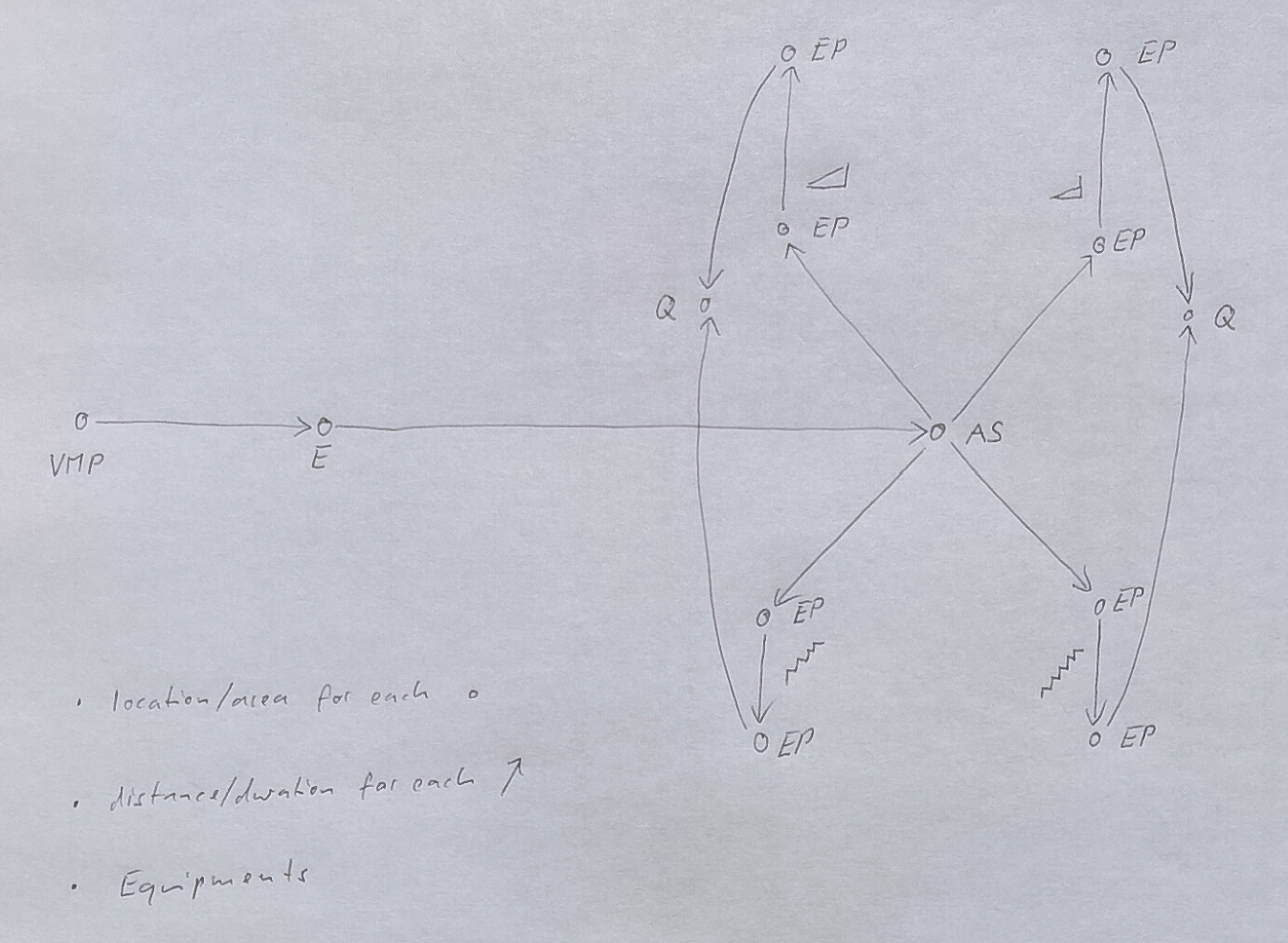
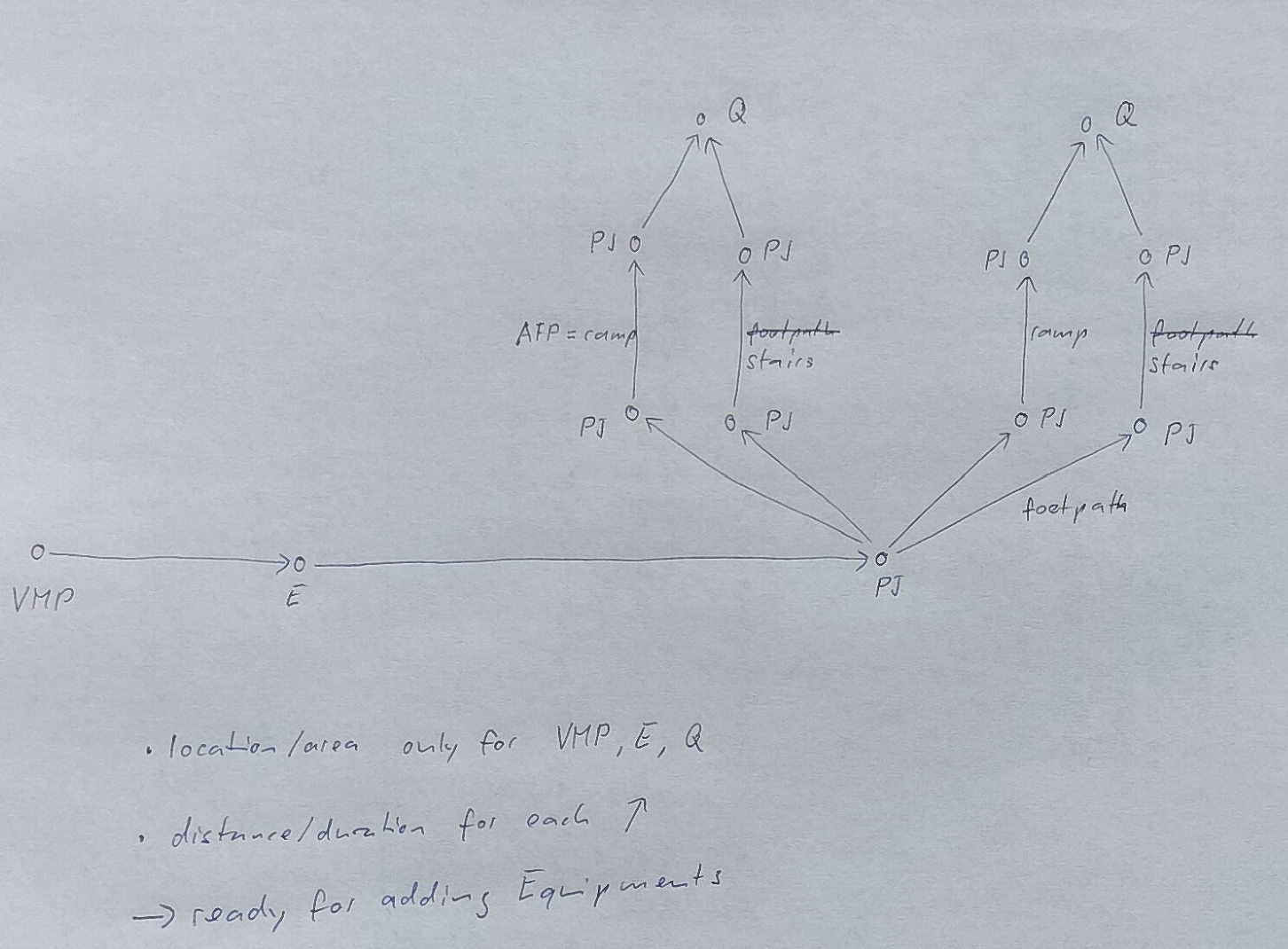
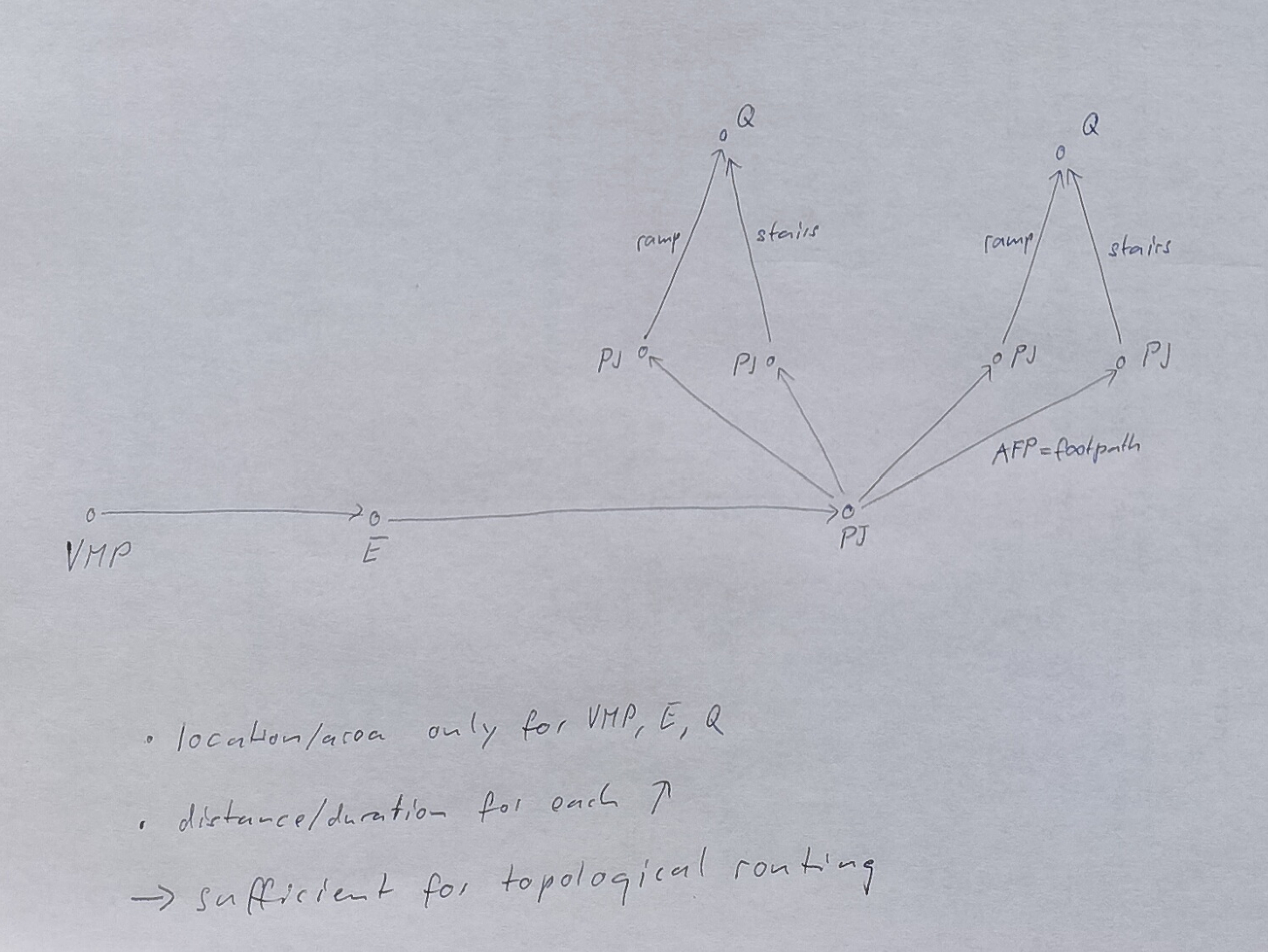
Three possible ways to model a navigation network from a VehicleMeetingPoint to two Quays.
The first model includes localised vertices (e.g., Entrance, EquipmentPlace) connected by SitePathLinks and AccessEquipments (StairEquipment, RampEquipment).
VMP = VehicleMeetingPoint, E = Entrance, AS = AccessSpace, EP = EquipmentPlace, Q = Quay, arrow = SitePathLink
The second model uses localised and possibly non-localised (PathJunction) vertices, connected by similar SitePathLinks as the first model, but without Equipments and EquipmentPlaces.
PJ = PathJunction
The third model is a streamlined form that doesn’t insist on PathJunctions if they don’t provide additional information needed for accessibility routing.
TEMPLATES FOR THIS DOCUMENT
NewElementX
→ Glossary definition TODO
Purpose
…
Table
NewElement.md
Example
NewElement.xml
→ Template
ExistingElementY - the Additional Elements
Table
OldElement_withAccessibility.md
Example
OldElement_withAccessibility.xml
→ Template